Duke Coach Mike Krzyzewski says President Obama is using wrong game plan against ISIS
http://www.washingtonpost.com/blogs/early-lead/wp/2014/11/04/duke-coach-mike-krzyzewski-says-president-obama-is-using-wrong-game-plan-against-isis/
There are hundreds of life lessons that you learn from playing sports at a high level. As Coach K has pointed out, Obama has telegraphed his troop draw-downs and "no boots on the ground" unnecessarily on multiple occasions which gives the enemy reason for encouragement. In addition, on first taking office he pulled out troops just when the "glue" of the Iraqi state was beginning to dry. See PBS Frontline "Losing Iraq."
PBS Frontline "Losing Iraq"
http://www.pbs.org/wgbh/pages/frontline/losing-iraq/
Wednesday, November 12, 2014

Monday, November 3, 2014
Great article on natural causes of what we call ADD
Great article on natural causes of what we call ADD. Asks the question that always comes up, is ADD really a disorder?
See also Dr. Amen's 7 types of ADD
A Natural Fix for A.D.H.D.
by Richard Friedman
http://www.nytimes.com/2014/11/02/opinion/sunday/a-natural-fix-for-adhd.html?smid=tw-share&_r=0
See also Dr. Amen's 7 types of ADD
A Natural Fix for A.D.H.D.
by Richard Friedman
http://www.nytimes.com/2014/11/02/opinion/sunday/a-natural-fix-for-adhd.html?smid=tw-share&_r=0
Saturday, October 25, 2014
Notes from Food Day with Joel Salatin
Notes from Food Day with Joel Salatin
At NOVA the community college where I teach, the Loudoun Campus held Food Day yesterday and somehow managed to get Joel Salatin to come. Amazingly, the audtitorium of 250 or so was only 2/3 full due to insufficient advertising, and half of those people were local DC area residents rather than NOVA students. But the morning speech and question and answer session by Salatin and the afternoon discussion panel were extremely informative, he was at his usual best.
A boggling amount of big ideas were thrown around, here are a few. Salatin said he was asked to focus on the economic aspects of food systems rather than the nature of farming itself, but as always he hit on a little bit of everything.
From Salatin:
-What do you pay for when you pay more for local food?
Intelligent farmers
Better land stewardship and preservation - many more eyes on the land
-Small local farms are very hard to get into big supermarkets because of all the bureaucracy and regulations involved. His farm and many others do not have vaccinated pigs and other measures required by supermarkets. There should not be "10 layers of bureaucracy" between a producer and transaction.
-Much discussion about how we do not include environmental and health costs in the cost of food and investments. Can you imagine going to a bank for a farm loan and the banker says that first he has to know what the effect on earthworms will be? Point was, we do not take into account the true effects of ways of farming including health, long term effects, effects on soil.
-Said an author says should spend a year walking a landscape and making notes before starting to farm there. Know the lanscape, eyes on the land.
-US has 2X more prisoners than farmers
-Private property should not deplete the commons.
-Much discussion on building vibrant, living soil and soil health is a key goal of farming. Contrasted with industrial farming which tends to create dead soil through chemical pesticides and overuse. Key word is "massage" soil and nature rather than pound it with chemicals. Want soil to be alive, tons of interesting living processes going on in the soil.
-GDP only counts cost of things we produce, not true value of them. Said Wendell Berry says GDP measures more about what's wrong than what's right. GDP not a measure of well-being.
-Mentioned Wendell Berry multiple times, midwestern poet.
-Know your farmer. If you visit a farmer at a farmer's market three times and he doesn't ask you to come visit, rule of thumb is there's a problem.
-Along same lines, local farmers can use GMOs and do not always produce grass-fed products. Have to ask if they are grain fed and use GMO.
-Costco does not accept a truck smaller than an 18-wheeler which excludes most small farmers.
-Pigs love acorns and do well on them, can live in forest easily. Plenty of biomass to feed animals all over the place, going wasted.
-Along same lines, use silviculture i.e. forestry to harvest biomass.
-"What's worth doing is worth doing poorly." In reference to starting new habits like cooking at home and buying from local farmers. Gave analogy of a toddler in a diaper trying to stand up. Even if they can't do it perfectly, it is worth doing, keeping at it. Should encourage it.
-Fundamentally a good food system has to be home-centered. Has to be based in cooking your own food.
-Great exchange when a lady raised her hand and complained that cooking at home is hard "who has 2 hours every night with kids? and that local/organic food was too expensive and about having been poor and had only pennies and was forced to eat Spaghetti-Os. Salatin did not give it second thought, he must have heard this 1000 times: "Have you every bought a 50 pound bag of oats? You can live a long time on a 50 pound bag of oats." In sum he said he doesn't believe in "I can't."
Considering that Spaghetti Os are just basically cans of flour, oats is easily a substitute, healthier because it has more fiber and much cheaper in bulk. Also mentioned a Crock Pot, how easy it is to throw stuff in and have it ready at night with minimal effort. To me, this lady simply didn't have any idea how to cook or buy food or know anything about nurtition. If it takes you at least 2 hours to cook, you don't belong in a kitchen.
-Asked if there is any country whose food system is not broken and can serve as a model. At first he said he didn't know of any but then mentioned some things below going on in other countries.
-In Zimbabwe he mentioned Allan Savory from TED Talks said they have an innovative tax system for farmers: farm taxes start out very high but you can lower them in three ways which include reducing erosion, creating more biodiversity, lowering toxicity. Each one lowers tax, if you do all three, you pay no tax. Pretty cool. Said they have a monitoring box that goes in the ground to check soil runoff and pesticide.
-Mentioned he was in mountainous New Zealand and said that while it is famous for being one of the "greenest" countries in the world, he said it was not a good example of a good food system. Said he saw heavy superphosphate use as fertilizer for sheep and dairy farms and major hillside erosion dumping phosphates into rivers.
-Mentioned that he was in the Netherlands and saw a vending machine that dispenses raw milk. I found this article:
http://modernfarmer.com/2014/03/americans-envy-europes-raw-milk-vending-machines/
-Got into politics somewhat. Emphasized that federal government needs to be shrunk while local needs to be strengthened. Mentioned Jeffersonian ideals, the Gentleman Farmer. Said that strengthening local government encourages a culture of innovation. (see Tocqueville and also the principle of subsidiarity).
-Mentioned he is half Spanish. I knew he lived in Venezuela as a kid but did not know he had Spanish heritage.
-Emphasized that there is tons of extra money around for the "extra" cost of good food.
-Emphasized all the wasted time among young people on video games, TV, and partying on Friday nights. Said if they could harness that energy could do great things.
-For young aspiring farmers, suggested finding a farmer and going to work for him, not necessarily as apprentice just doing stuff for him like digging fence posts. For some sort of relationship.
-Asked if going to college for agriculture degree was worth it, like Virginia Tech? No.
-Mentioned that many synthetics are not the same as the real thing. Example: CLA (conjugated linoleic acid) one of the key good fats in red meat. You can buy a synthetic version in the Vitamin Shoppe but it has one neutron difference from the real thing - "nobody knows the importance of that one neutron."
-Emphasized that current laws against raw milk are leftovers of the early industrial era when toxins abounded in cities, horse poop was all over the streets in major cities. Said the laws are long outdated and no reason why raw milk should not be sold among consenting adults.
-Gave example of innovative food sovereignty law in Sedgewick, Maine. 1/2 page law would allow citizens to buy and sell whatever they want, including raw milk. I found this article
http://www.naturalnews.com/039633_sedgwick_food_freedom_federal_laws.html
-Polyface does not deliver over 4 hours. Believes it is good to be local.
-Emphasized that "organic" does not mean healthy and that many unhealthy things can pass as organic.
-176 synthetics allowed in "organic" food.
-"Free range" actually just means chickens can leave cage in a small three foot space, does not mean they roam freely
-Emphasized the problem with organic labels is they are not comprehensive. Since different standards apply to each food, should not be graded on a "pass/fail" basis. Should be scored on multiple categories and sliding scales.
-New Virginia law proposed: buy food of choice from farmer of choice. 2 year process, will be on ballot in future. Citizens could sue state for denying food sovereignty.
-Emphasized that the reason food choice is not in the Bill of Rights is because it is so fundamental the Founding Fathers could not imagine not having the right to buy and sell food.
-Genetic Trespass could outlaw GMOs - meaning non GMO farmers could sue GMO farmers for having their seeds trespass into their field by wind, water, etc.
-Encourage multi-speciated, stacking, regenerative, productive, enterprising, mosaic
-Wheat normally ferments in the harvesting process as it is stored in bails bunched up. With modern harvesting, however, wheat is not stored, instantly gathered so no time to ferment. This changes its properities especially digestibility.
-Chicken manure 11 to 1 fertilizer strength vs. cow manure
-Mentioned Sweden is opening up land in north expecting warmer climate with climate change, hopes to add population and agriculture
-Values matter
-Europe has fewere GMOs
-Different GMOs are allowed for animal feed vs. feeding people
Other speakers:Biotechnology speaker gave example of a good use of GMOs, saving American chestnut trees from extinction.
Roundup phosphate has created resistance and superweeds
Glyphosate in wheat sprayed to keep from bunching up, could be link to disease. Other panelist said glyphosate breaks down quickly.
Audience member said in India cotton growers used at BT genetically modified cotton and had diseases, likely from the pesticides and fertilizers. Had a lot of cotton but not worth it.
-Hawaii - GMO papayas - getting infections
At NOVA the community college where I teach, the Loudoun Campus held Food Day yesterday and somehow managed to get Joel Salatin to come. Amazingly, the audtitorium of 250 or so was only 2/3 full due to insufficient advertising, and half of those people were local DC area residents rather than NOVA students. But the morning speech and question and answer session by Salatin and the afternoon discussion panel were extremely informative, he was at his usual best.
A boggling amount of big ideas were thrown around, here are a few. Salatin said he was asked to focus on the economic aspects of food systems rather than the nature of farming itself, but as always he hit on a little bit of everything.
From Salatin:
-What do you pay for when you pay more for local food?
Intelligent farmers
Better land stewardship and preservation - many more eyes on the land
-Small local farms are very hard to get into big supermarkets because of all the bureaucracy and regulations involved. His farm and many others do not have vaccinated pigs and other measures required by supermarkets. There should not be "10 layers of bureaucracy" between a producer and transaction.
-Much discussion about how we do not include environmental and health costs in the cost of food and investments. Can you imagine going to a bank for a farm loan and the banker says that first he has to know what the effect on earthworms will be? Point was, we do not take into account the true effects of ways of farming including health, long term effects, effects on soil.
-Said an author says should spend a year walking a landscape and making notes before starting to farm there. Know the lanscape, eyes on the land.
-US has 2X more prisoners than farmers
-Private property should not deplete the commons.
-Much discussion on building vibrant, living soil and soil health is a key goal of farming. Contrasted with industrial farming which tends to create dead soil through chemical pesticides and overuse. Key word is "massage" soil and nature rather than pound it with chemicals. Want soil to be alive, tons of interesting living processes going on in the soil.
-GDP only counts cost of things we produce, not true value of them. Said Wendell Berry says GDP measures more about what's wrong than what's right. GDP not a measure of well-being.
-Mentioned Wendell Berry multiple times, midwestern poet.
-Know your farmer. If you visit a farmer at a farmer's market three times and he doesn't ask you to come visit, rule of thumb is there's a problem.
-Along same lines, local farmers can use GMOs and do not always produce grass-fed products. Have to ask if they are grain fed and use GMO.
-Costco does not accept a truck smaller than an 18-wheeler which excludes most small farmers.
-Pigs love acorns and do well on them, can live in forest easily. Plenty of biomass to feed animals all over the place, going wasted.
-Along same lines, use silviculture i.e. forestry to harvest biomass.
-"What's worth doing is worth doing poorly." In reference to starting new habits like cooking at home and buying from local farmers. Gave analogy of a toddler in a diaper trying to stand up. Even if they can't do it perfectly, it is worth doing, keeping at it. Should encourage it.
-Fundamentally a good food system has to be home-centered. Has to be based in cooking your own food.
-Great exchange when a lady raised her hand and complained that cooking at home is hard "who has 2 hours every night with kids? and that local/organic food was too expensive and about having been poor and had only pennies and was forced to eat Spaghetti-Os. Salatin did not give it second thought, he must have heard this 1000 times: "Have you every bought a 50 pound bag of oats? You can live a long time on a 50 pound bag of oats." In sum he said he doesn't believe in "I can't."
Considering that Spaghetti Os are just basically cans of flour, oats is easily a substitute, healthier because it has more fiber and much cheaper in bulk. Also mentioned a Crock Pot, how easy it is to throw stuff in and have it ready at night with minimal effort. To me, this lady simply didn't have any idea how to cook or buy food or know anything about nurtition. If it takes you at least 2 hours to cook, you don't belong in a kitchen.
-Asked if there is any country whose food system is not broken and can serve as a model. At first he said he didn't know of any but then mentioned some things below going on in other countries.
-In Zimbabwe he mentioned Allan Savory from TED Talks said they have an innovative tax system for farmers: farm taxes start out very high but you can lower them in three ways which include reducing erosion, creating more biodiversity, lowering toxicity. Each one lowers tax, if you do all three, you pay no tax. Pretty cool. Said they have a monitoring box that goes in the ground to check soil runoff and pesticide.
-Mentioned he was in mountainous New Zealand and said that while it is famous for being one of the "greenest" countries in the world, he said it was not a good example of a good food system. Said he saw heavy superphosphate use as fertilizer for sheep and dairy farms and major hillside erosion dumping phosphates into rivers.
-Mentioned that he was in the Netherlands and saw a vending machine that dispenses raw milk. I found this article:
http://modernfarmer.com/2014/03/americans-envy-europes-raw-milk-vending-machines/
-Got into politics somewhat. Emphasized that federal government needs to be shrunk while local needs to be strengthened. Mentioned Jeffersonian ideals, the Gentleman Farmer. Said that strengthening local government encourages a culture of innovation. (see Tocqueville and also the principle of subsidiarity).
-Mentioned he is half Spanish. I knew he lived in Venezuela as a kid but did not know he had Spanish heritage.
-Emphasized that there is tons of extra money around for the "extra" cost of good food.
-Emphasized all the wasted time among young people on video games, TV, and partying on Friday nights. Said if they could harness that energy could do great things.
-For young aspiring farmers, suggested finding a farmer and going to work for him, not necessarily as apprentice just doing stuff for him like digging fence posts. For some sort of relationship.
-Asked if going to college for agriculture degree was worth it, like Virginia Tech? No.
-Mentioned that many synthetics are not the same as the real thing. Example: CLA (conjugated linoleic acid) one of the key good fats in red meat. You can buy a synthetic version in the Vitamin Shoppe but it has one neutron difference from the real thing - "nobody knows the importance of that one neutron."
-Emphasized that current laws against raw milk are leftovers of the early industrial era when toxins abounded in cities, horse poop was all over the streets in major cities. Said the laws are long outdated and no reason why raw milk should not be sold among consenting adults.
-Gave example of innovative food sovereignty law in Sedgewick, Maine. 1/2 page law would allow citizens to buy and sell whatever they want, including raw milk. I found this article
http://www.naturalnews.com/039633_sedgwick_food_freedom_federal_laws.html
-Polyface does not deliver over 4 hours. Believes it is good to be local.
-Emphasized that "organic" does not mean healthy and that many unhealthy things can pass as organic.
-176 synthetics allowed in "organic" food.
-"Free range" actually just means chickens can leave cage in a small three foot space, does not mean they roam freely
-Emphasized the problem with organic labels is they are not comprehensive. Since different standards apply to each food, should not be graded on a "pass/fail" basis. Should be scored on multiple categories and sliding scales.
-New Virginia law proposed: buy food of choice from farmer of choice. 2 year process, will be on ballot in future. Citizens could sue state for denying food sovereignty.
-Emphasized that the reason food choice is not in the Bill of Rights is because it is so fundamental the Founding Fathers could not imagine not having the right to buy and sell food.
-Genetic Trespass could outlaw GMOs - meaning non GMO farmers could sue GMO farmers for having their seeds trespass into their field by wind, water, etc.
-Encourage multi-speciated, stacking, regenerative, productive, enterprising, mosaic
-Wheat normally ferments in the harvesting process as it is stored in bails bunched up. With modern harvesting, however, wheat is not stored, instantly gathered so no time to ferment. This changes its properities especially digestibility.
-Chicken manure 11 to 1 fertilizer strength vs. cow manure
-Mentioned Sweden is opening up land in north expecting warmer climate with climate change, hopes to add population and agriculture
-Values matter
-Europe has fewere GMOs
-Different GMOs are allowed for animal feed vs. feeding people
Other speakers:Biotechnology speaker gave example of a good use of GMOs, saving American chestnut trees from extinction.
Roundup phosphate has created resistance and superweeds
Glyphosate in wheat sprayed to keep from bunching up, could be link to disease. Other panelist said glyphosate breaks down quickly.
Audience member said in India cotton growers used at BT genetically modified cotton and had diseases, likely from the pesticides and fertilizers. Had a lot of cotton but not worth it.
-Hawaii - GMO papayas - getting infections
Tuesday, August 19, 2014
Great diagram of stages of atherosclerosis/cardiovascular disease
Great diagram of stages of atherosclerosis/cardiovascular disease.

Monday, August 11, 2014
Great page on ACTN3 Gene aka the speed gene
The ACTN3 is sometimes called the "speed gene" but really it is not the only gene involved in speed. R is the "speed" allele while X is the "endurance" allele. However, the site below makes it pretty clear that few endurance champions have this gene whereas lots of sprinting champions do.
Having said that, there have been some (though very few) Olympic power sport champions who have no working copies of the gene.
Other genes involved include the APOE gene.
Great page on ACTN3 Gene aka the speed gene
http://kohlmanngen677s13.weebly.com/
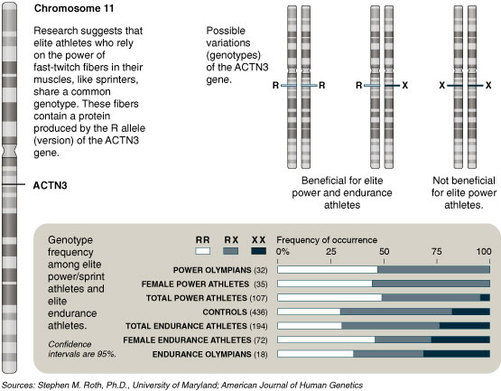
Having said that, there have been some (though very few) Olympic power sport champions who have no working copies of the gene.
Other genes involved include the APOE gene.
Great page on ACTN3 Gene aka the speed gene
http://kohlmanngen677s13.weebly.com/
Monday, July 21, 2014
Great explanation of the function of sirtuin proteins -- the skinny gene proteins
"Sirtuin proteins (SIRTs) are created when the body recognizes a caloric deficit, they do three things we are concerned with:
1) they run around the body cleaning up old, dead cells; and the innards of cells that are sickly. They send the detritus to be burned as fuel. And, in the process of cleaning up they can make great improvements in our health.
2) they support fat burning, in fact they appear to be critical to making the body burn fat and preserve muscle
3) for some of us, they reduce feelings of hunger
Sounds great, doesn't it? It is. The trick is that the body only generates them for a fairly short time. After an average of 40 hours, if the body is still in a calorie deficit, it stops producing SIRTs and changes over to burning fat and muscle.
By eating very low one day, we invoke the SIRTs and burn fat (and get a nice internal dusting and cleaning). By eating high the next day, we turn off the calorie deficit and prevent muscle being used for fuel. That is the magic to the rotation.
Gradually, over time, we accumulate enough SIRTs that they hang around and keep working on UD. At that point, weight loss usually speeds up a bit...even if it does not speed up, it becomes very stable and predictable.
When we have a - ahem - body-full of SIRTs, it takes about two weeks to burn them all away. That is why going on vacation for a week or so may cause a bounce, but returning to the rotation and losing the bounce is usually very easy.
I hope that helps."
-------------------------------
Taken from this blog
http://www.lowcarbfriends.com/bbs/juddd/794318-magical-gene-what.html
about halfway down
1) they run around the body cleaning up old, dead cells; and the innards of cells that are sickly. They send the detritus to be burned as fuel. And, in the process of cleaning up they can make great improvements in our health.
2) they support fat burning, in fact they appear to be critical to making the body burn fat and preserve muscle
3) for some of us, they reduce feelings of hunger
Sounds great, doesn't it? It is. The trick is that the body only generates them for a fairly short time. After an average of 40 hours, if the body is still in a calorie deficit, it stops producing SIRTs and changes over to burning fat and muscle.
By eating very low one day, we invoke the SIRTs and burn fat (and get a nice internal dusting and cleaning). By eating high the next day, we turn off the calorie deficit and prevent muscle being used for fuel. That is the magic to the rotation.
Gradually, over time, we accumulate enough SIRTs that they hang around and keep working on UD. At that point, weight loss usually speeds up a bit...even if it does not speed up, it becomes very stable and predictable.
When we have a - ahem - body-full of SIRTs, it takes about two weeks to burn them all away. That is why going on vacation for a week or so may cause a bounce, but returning to the rotation and losing the bounce is usually very easy.
I hope that helps."
-------------------------------
Taken from this blog
http://www.lowcarbfriends.com/bbs/juddd/794318-magical-gene-what.html
about halfway down
2 ways that grains actually can be "good for you"
I hesitate to use the phrase "good for you" about foods because usually foods have both good, bad, and neutral aspects to them nutritionally that depend on *you* specifically, your body, you metabolism, your allergies, your digestion, etc. So you have to weigh all of the above.
Grains are being knocked these days for having "no nutritional value" and even for having "anti-nutrients." But actually this is not true. Grains are often compared to vegetable sources of carbs and found to lack the same variety of vitamins and phytonutrients, but they have advantages of their own. I'm certainly not advocating chowing down on grains and bread all day as the SAD diet suggests (Standard American Diet). But here are two ways that whole grains (only whole grains) help reduce heart disease:
-Whole grains (ex. brown rice, whole wheat) have something called DMG which converts to something else called TMG in the body. Straight TMG is highly-valued in nutrition and found in greens like spinach. It is a key to preventing heart disease because it breaks down destructive homocysteine that comes from eating lots of protein. Homocysteine is one of the key markers of heart disease, it literally shreds your arteries in a way analogous to tiny bits of broken glass.
-Further, phytic acid is often called an "anti-nutrient" because it strips away iron from the blood stream by chelating it (binding to it). However, if you are trying to avoid iron overload, this may be just what you need. The "anti-nutrient" label comes mostly from people thinking about iron deficiency, but there are loads of people (more guys than women) with excess iron that they need to reduce. So one man's anti-nutrient is another man's nutrient. In fact, for people with real iron overload problems, rather than giving blood frequently which has been the only solution until recently, you can simply get something called IP6 which contains phytic acid and your iron will come down extremely fast without all the fatigue of having to lose blood. (see previous post)
So whole grains definitely have their good side. Imagine if you eat a side a brown rice with a steak: the phytic acid reduces the iron form the steak, which can be good because it prevents that iron from banging around in your arteries creating nicks, while the DMG reduces the homocysteine from the steak. So it is worth noting these big benefits to grains, while remembering to eat whole grains and to eat them in moderation, according to your own personal nutritional type.
Grains are being knocked these days for having "no nutritional value" and even for having "anti-nutrients." But actually this is not true. Grains are often compared to vegetable sources of carbs and found to lack the same variety of vitamins and phytonutrients, but they have advantages of their own. I'm certainly not advocating chowing down on grains and bread all day as the SAD diet suggests (Standard American Diet). But here are two ways that whole grains (only whole grains) help reduce heart disease:
-Whole grains (ex. brown rice, whole wheat) have something called DMG which converts to something else called TMG in the body. Straight TMG is highly-valued in nutrition and found in greens like spinach. It is a key to preventing heart disease because it breaks down destructive homocysteine that comes from eating lots of protein. Homocysteine is one of the key markers of heart disease, it literally shreds your arteries in a way analogous to tiny bits of broken glass.
-Further, phytic acid is often called an "anti-nutrient" because it strips away iron from the blood stream by chelating it (binding to it). However, if you are trying to avoid iron overload, this may be just what you need. The "anti-nutrient" label comes mostly from people thinking about iron deficiency, but there are loads of people (more guys than women) with excess iron that they need to reduce. So one man's anti-nutrient is another man's nutrient. In fact, for people with real iron overload problems, rather than giving blood frequently which has been the only solution until recently, you can simply get something called IP6 which contains phytic acid and your iron will come down extremely fast without all the fatigue of having to lose blood. (see previous post)
So whole grains definitely have their good side. Imagine if you eat a side a brown rice with a steak: the phytic acid reduces the iron form the steak, which can be good because it prevents that iron from banging around in your arteries creating nicks, while the DMG reduces the homocysteine from the steak. So it is worth noting these big benefits to grains, while remembering to eat whole grains and to eat them in moderation, according to your own personal nutritional type.
Subscribe to:
Posts (Atom)